
Anyone who deals with telephone and meeting boxes and is planning a corresponding purchase will sooner or later stumble across the topic of sound insulation classes, sound insulation and possible differences in quality. Telephone and meeting boxes are typically categorised into so-called sound insulation classes, of which the three sound insulation classes A, B and C play a role in practice (ISO 23351-1, see also „Selection criterion: Sound insulation“):
| Sound insulation classes | Speech level reduction | Star classification Ninty-Nine-Cubes* | Use |
|---|---|---|---|
| Class A+ | > 33 dB | ★★★★★ | Recording studio | Industry |
| Class A | 30-33 dB | ★★★★☆ | Loud / very quiet office |
| Class B | 25-30 dB | ★★★☆☆ | normal office |
| Class C | 20-25 dB | ★★☆☆☆ | Conditionally suitable |
| Class D | 15-20 dB | ★☆☆☆☆ |
As a manufacturer-independent provider of telephone and meeting boxes, we hold consultations with potential customers day in, day out. The question of the right sound insulation is often at the centre of the consultation: What sound insulation do we need for our telephone boxes? Does it have to be the best of the best or is one class lower enough? With the following overview and the explanations below, we try to categorise what can be achieved with different sound insulation classes.
Why is the background noise so important for sound insulation?
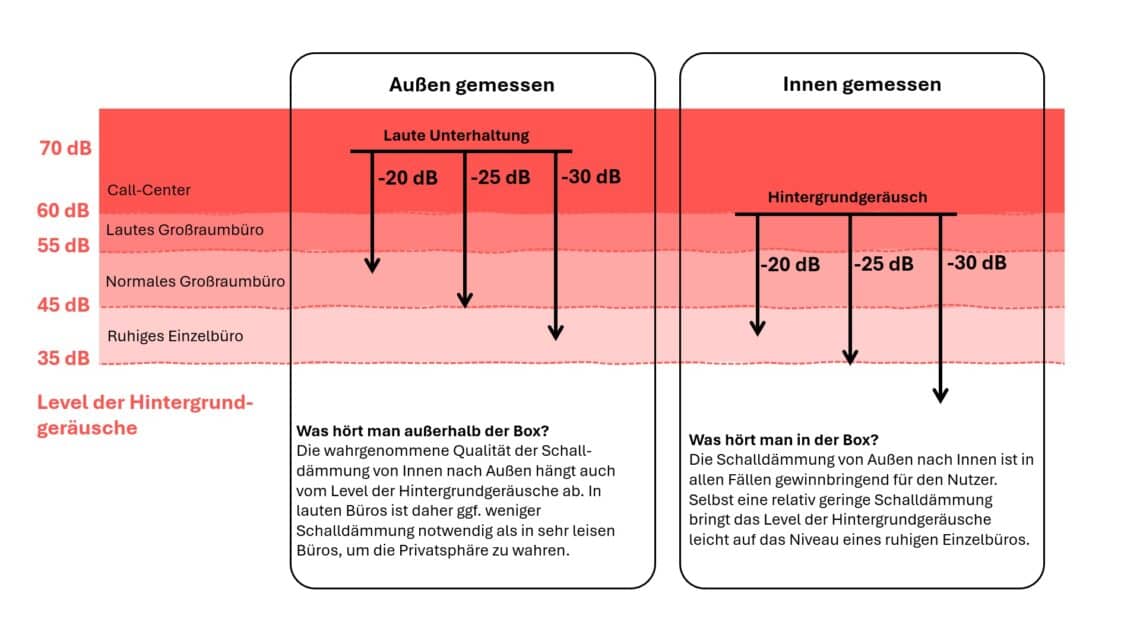
The louder the background noise, the easier it is for sounds or snatches of conversation from a telephone box to be drowned out in the surroundings. This leads to the somewhat paradoxical conclusion that a lower level of sound insulation may be sufficient in particularly noisy offices. As a rule of thumb, the sound insulation of a telephone box should be so good that the insulated sound level is 2 to 3 decibels below the lower limit of the typical background noise of the office environment. This ensures that no-one involuntarily has to „listen in“ on calls from the telephone box outside.
For the users inside a telephone or meeting box, on the other hand, it is more important to be sufficiently shielded from the background noise of an open-plan office, which may be perceived as too loud. This is relatively easy to achieve: even a relatively low level of sound insulation easily brings the level of background noise down to that of a quiet individual office.
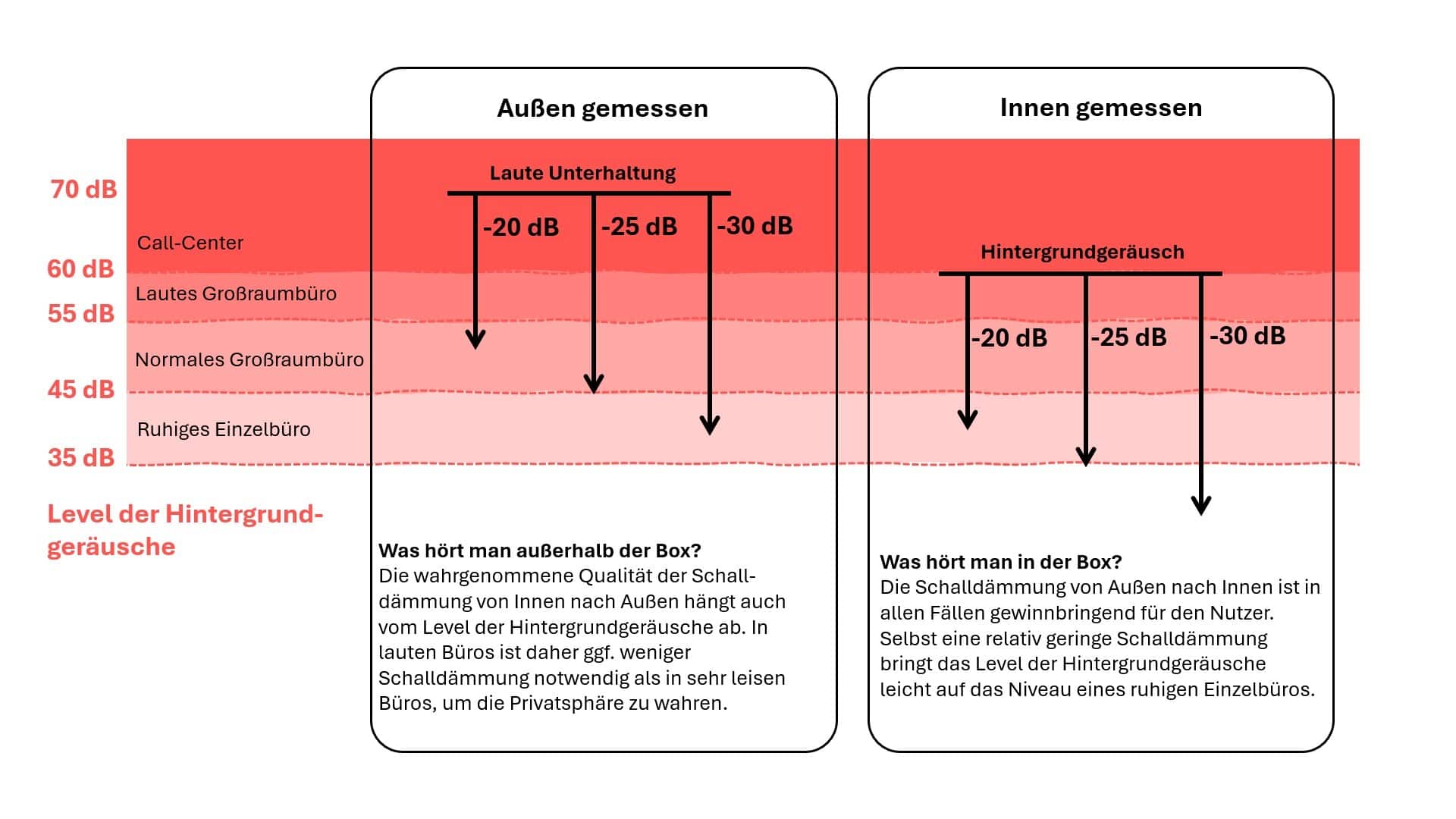
Explanation of the graphic: Sound insulation in telephone boxes works in two directions (outwards and inwards). The aim is to provide privacy on the outside and concentration on the inside. A loud conversation has a volume of approx. 70 dB. If the conversation takes place in an acoustic cube, this can be reduced by up to 30 dB (resulting in approx. 40 dB), depending on the sound insulation. In a normal open-plan office, this is then below the perception threshold (overlaid by background noise). For users inside the box, the primary aim is to achieve the level of a quiet individual office. This can be achieved sufficiently well even with lower sound insulation.
What level of background noise is typical in offices?
Even in very quiet offices, it is never completely quiet: Noise from the street, fan noise from PCs and laptops, typing noises on the keyboard - almost everything generates background noise to a greater or lesser extent. Typically, the level of average background noise can be categorised into the following types of office environments:
- Call centre: Call centres are among the loudest working environments in the office world - the noise level here is often over 60 decibels.
- Noisy open-plan office: An open-plan office is said to be noisy if the average background noise level is between 55 and 60 decibels.
- Normal open-plan office: In normal open-plan offices, the background noise ranges between 45 and 55 decibels.
- Quiet single office: If you have the privilege of working in a single office, you still have 35 to 45 decibels of background noise.
Interestingly, a certain amount of background noise is actually desirable. In complete silence, even the smallest noise is suddenly perceived as disturbing and can be a concentration killer. If, on the other hand, the background noise is quiet but consistent, a so-called „sound masking“ effect occurs - the human ear then no longer perceives certain noises as disturbing.
For telephone and meeting boxes, this means that in particularly quiet environments, more attention must be paid to good sound insulation than with loud background noise. But be careful: open-plan offices are not always equally busy. On certain days of the week or at off-peak times, even lively open-plan offices are much quieter. This must be taken into account when choosing a suitable telephone box!
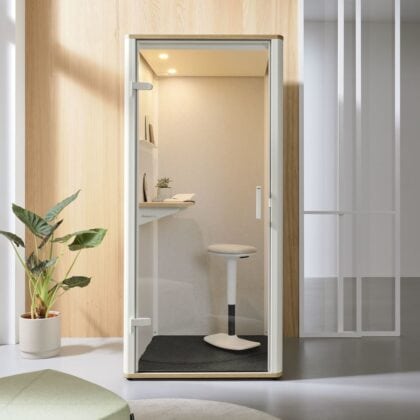
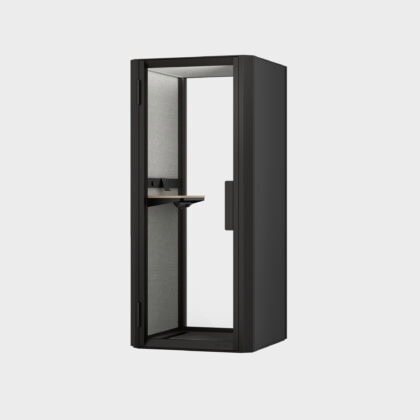
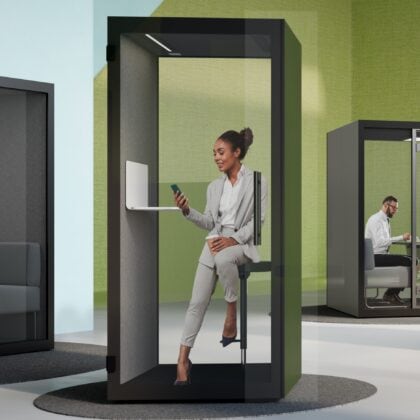
We offer acoustic cubes in all sound insulation classes in our range:

Questions, comments & personal advice
Are you missing any information or do you have any questions? Then please leave a comment below! You can also get free advice from us: