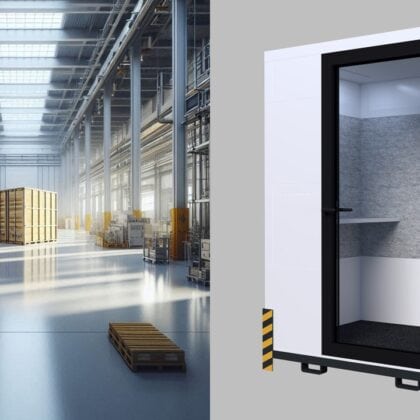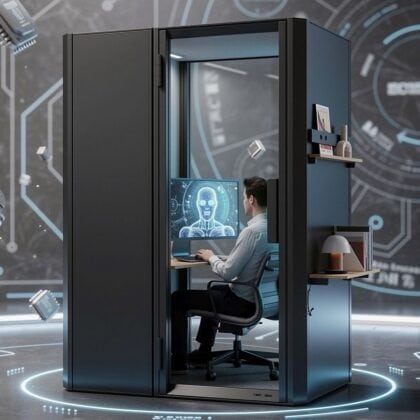
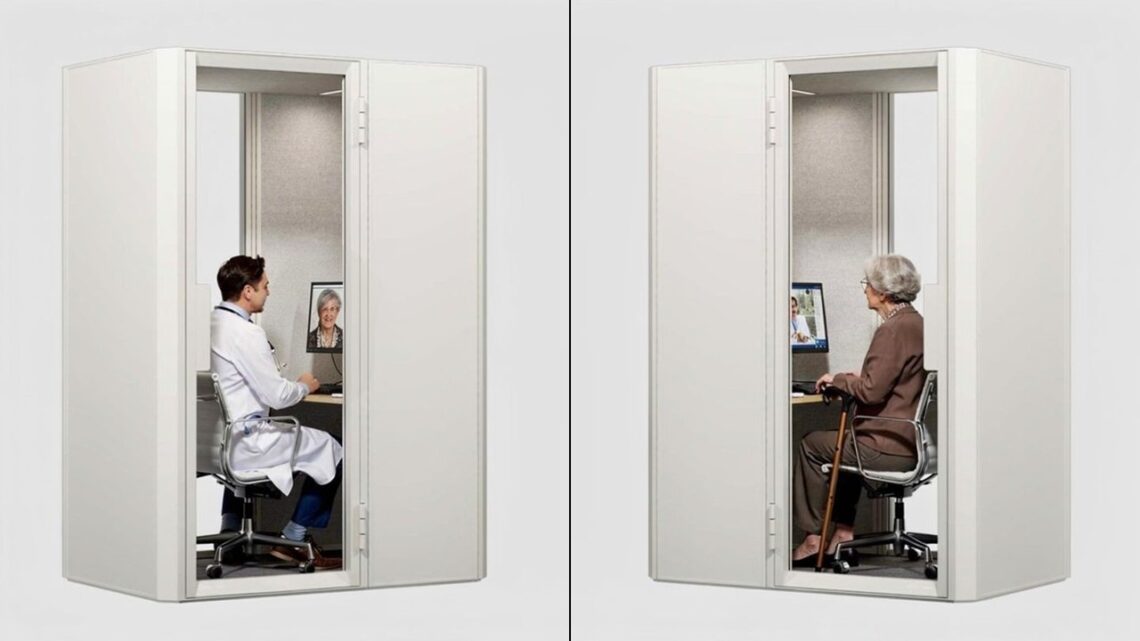
Telephone and meeting boxes or room-in-room systems are also increasingly in demand from the medical sector. The increasing demand for soundproofed, flexible rooms is a logical consequence of several structural developments in the medical sector, which we briefly discuss in the following article.
Contents
Acoustic cubes in telemedicine
In connection with telemedical applications, we have observed an increasing demand for telephone boxes and in particular the somewhat larger work boxes in recent years. As the classic treatment room in a doctor's surgery has lost its raison d'être in telemedicine, new spatial solutions are required for both doctor and patient.
One specific example is a large medical practice that offers video consultations and needs to have several video call workstations available for this. To ensure that this works in a confined space and does not end up in a call centre atmosphere, soundproof booths are being discussed here to ensure the confidentiality of conversations between doctor and patient on the practice side.
For patients, too, telemedicine does not necessarily mean switching on a laptop from their own hospital bed. Pilot projects are currently being developed with concepts for a kind of „remote practice“ that could improve medical care in rural areas. The idea behind it: Using telemedicine to bring doctors to villages without their own medical practice. In concrete terms, this means setting up a branch of the doctor's surgery where medical assistants are present and can take blood samples, for example. In this constellation, however, the doctor would be connected via video call. A treatment room would not be necessary for this, but one or more soundproofed boxes would be sufficient to save space.
Another, somewhat more specialised use case is video call booths in pharmacies, where visitors can make an appointment with a doctor directly on site - and then receive a suitable prescription to fill at the pharmacy.
Room-in-room solutions for AI applications in medicine
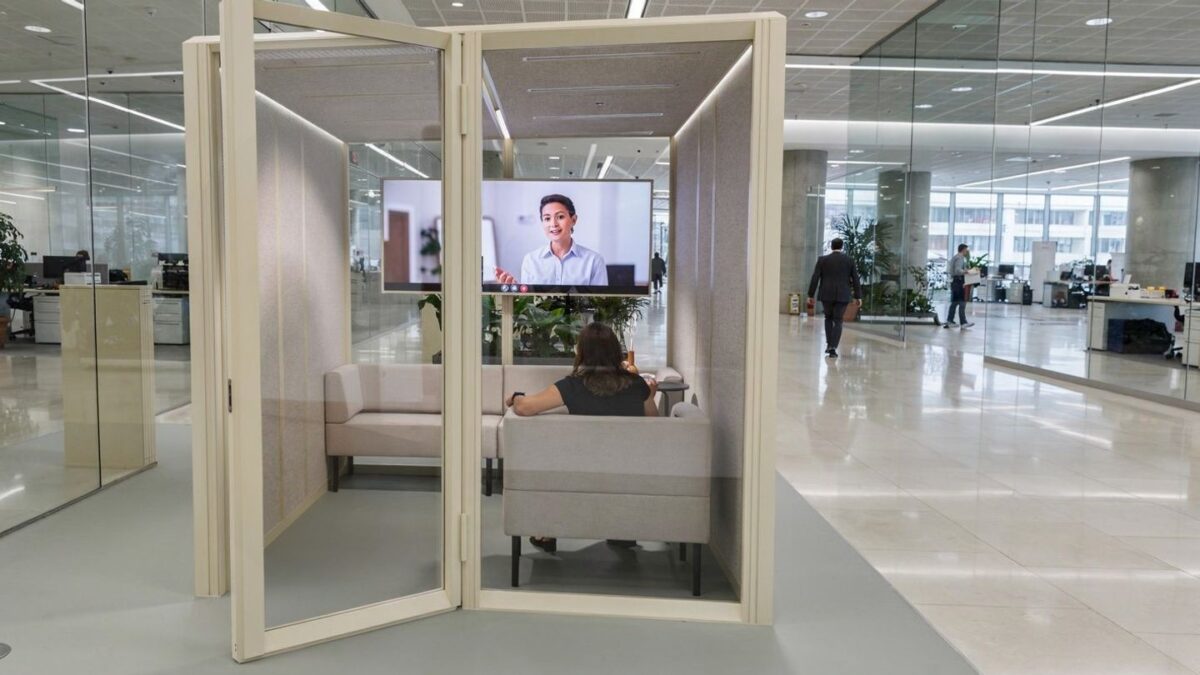
The potential applications for artificial intelligence are also currently being investigated in many research projects in the medical field and are even being trialled by some medical start-ups as a future business area.
If AI is not only used in the background (for example when analysing X-ray images) but also in direct patient contact, the question of the spatial solution automatically arises: a treatment room is far too large for interaction between patient and AI, but the hospital corridor is not suitable for such a situation either.
Depending on the specific application, acoustic cubes of different sizes could be used and equipped with the necessary technology (screen, camera, additional sensors if necessary).
We currently see voice-based AI chatbots in particular as potential AI applications in the hospital sector that we can support with acoustic cubes from our range: in times of staff shortages, AI chatbots could relieve medical staff of many organisational tasks. What's wrong with having an AI chatbot take care of the typical questions during the first admission to hospital? Especially if it speaks all foreign languages and can answer questions patiently?
Hospitals: spatial densification instead of extensions
A rather classic application scenario for acoustic cubes is the spatial redensification of existing areas. In this respect, the situation in hospitals differs little from the situation in office buildings. Nevertheless, there are differences: hospitals generally have much more traffic areas - i.e. foyers, waiting areas, corridors and technical rooms. There are many opportunities for densification in hospitals without significantly impairing the quality of these areas.
Acoustic cubes for use in (tele)medicine
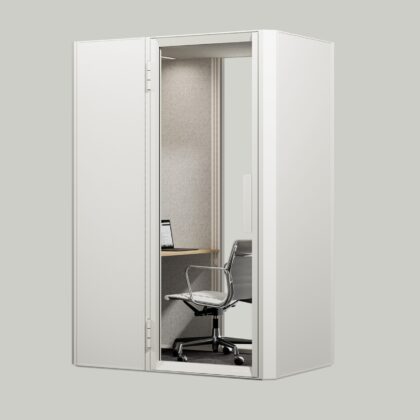
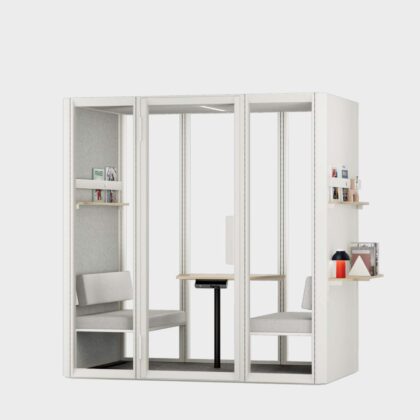
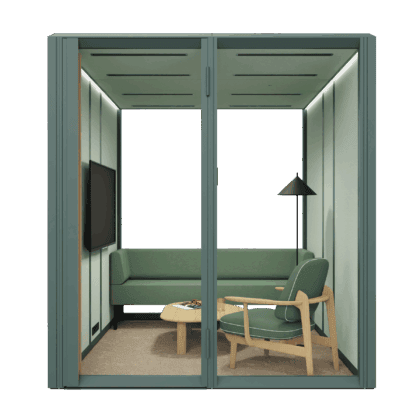
Some of our acoustic cubes are particularly suitable for use in a medical environment or for telemedical applications. We would be happy to advise you on this in a personal consultation!

Questions, comments & personal advice
Are you missing any information or do you have any questions? Then please leave a comment below! You can also get free advice from us: